Want to know The Truth About CPM?

08 July 2014

What's coming in Planning 11.1.2.4

Before I begin

Like many of the oh-so-cool previews at Kscope14, this session by Shankar Viswanathan (Planning Product Manager) and Prasad Kulkarni (Planning Development Manager) was prefaced by a slide that looked quite a bit like this:
That’s from the Thursday Planning Deep Dive but the text is (I am 100% sure because I got it from the Essbase PM) Oracle’s.  

Mentioning this is just my way of warning you that everything I saw, and everything I am going to relate, and the super cool demo that you can see all may come true.  Maybe.  Or it may not.  Oracle are very clear that this is what they would like to see happen but as always with plans, Planning PSU4 (aka Planning 11.1.2.4) may not occur, Planning PSU4 may not occur when they hope, Planning PSU4 may cause Redwood Shores to sink into the sea, etc.  In other words, enjoy the below but no more.  I certainly hope it all comes true.

The key takeaways

I was pretty much blown away by what I saw both because many of the papercuts have been resolved and because Oracle have added so many new bits of functionality.  

Looking at my notes from Shankar and Prasad’s session, I see the following coming for Patch Set Update (PSU) 4:
  • Improved performance
  • Sandboxing
  • Client side calculations
  • Valid Combinations

Performance

Forms

Performance in Planning forms has been an issue for just about as long as there has been a Hyperion Planning.  As of 11.1.2.0 and a usable version of Smart View with Planning, I’ve recommended that clients who want speed (and in general just want decent functionality) to go the Planning/Smart View route.  Now I may have to rethink that.

From a performance perspective, Oracle are now claiming that a form with over 100,000 cells now loads in about five seconds.  Hmm, that’s pretty darn quick.  How do they do it?

The difference now is that Oracle are now using ADF to pull data on demand very quickly.  I think that means that they aren’t really and truly pulling all 100,000 cells into the browser when a planner opens a form but instead they are paging it very quickly and intelligently prefetching the data as required.  From a human perspective, it seems instantaneous.  How many retrieves from Essbase actually occur (is it just one and Planning caches it or is it multiple quick retrieves – I don’t know and Oracle didn’t say) is difficult to tell but with performance like that, who cares?

What about the sends?  Surely there is an issue with that 100,000 cell send back to Essbase?  Nope, only the changed data is sent from Planning back to Essbase.  Cool, eh?

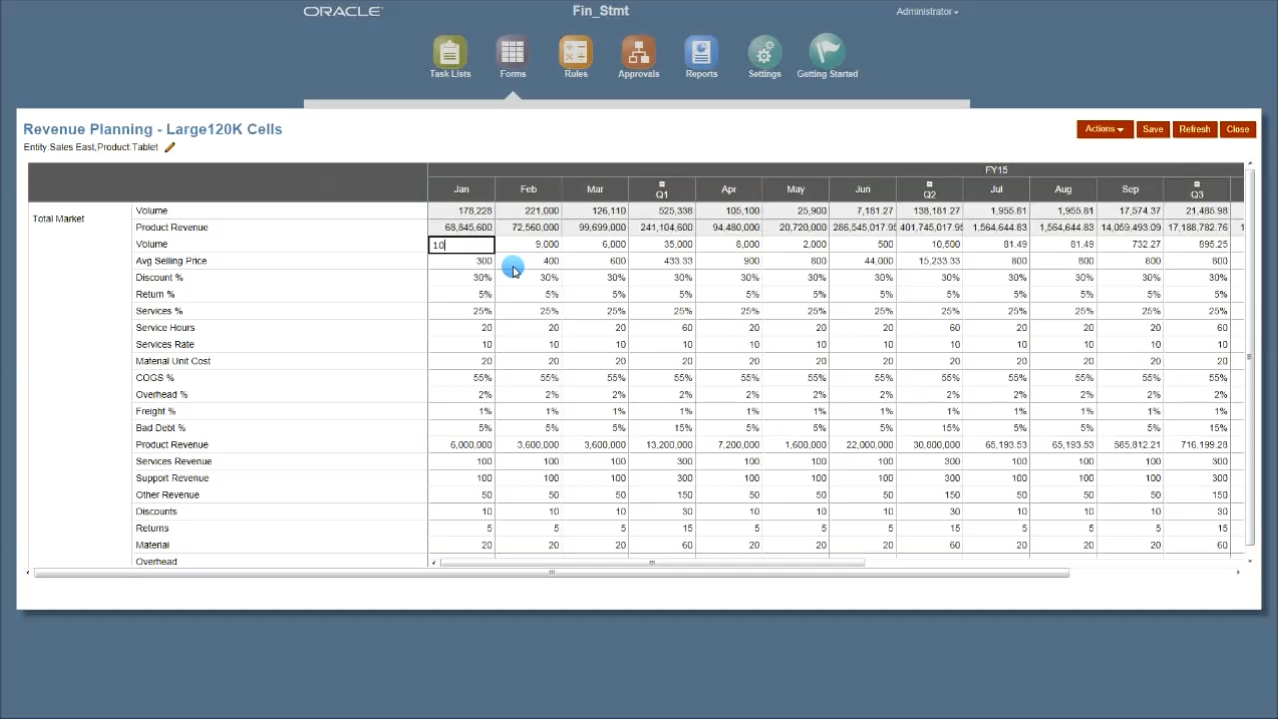
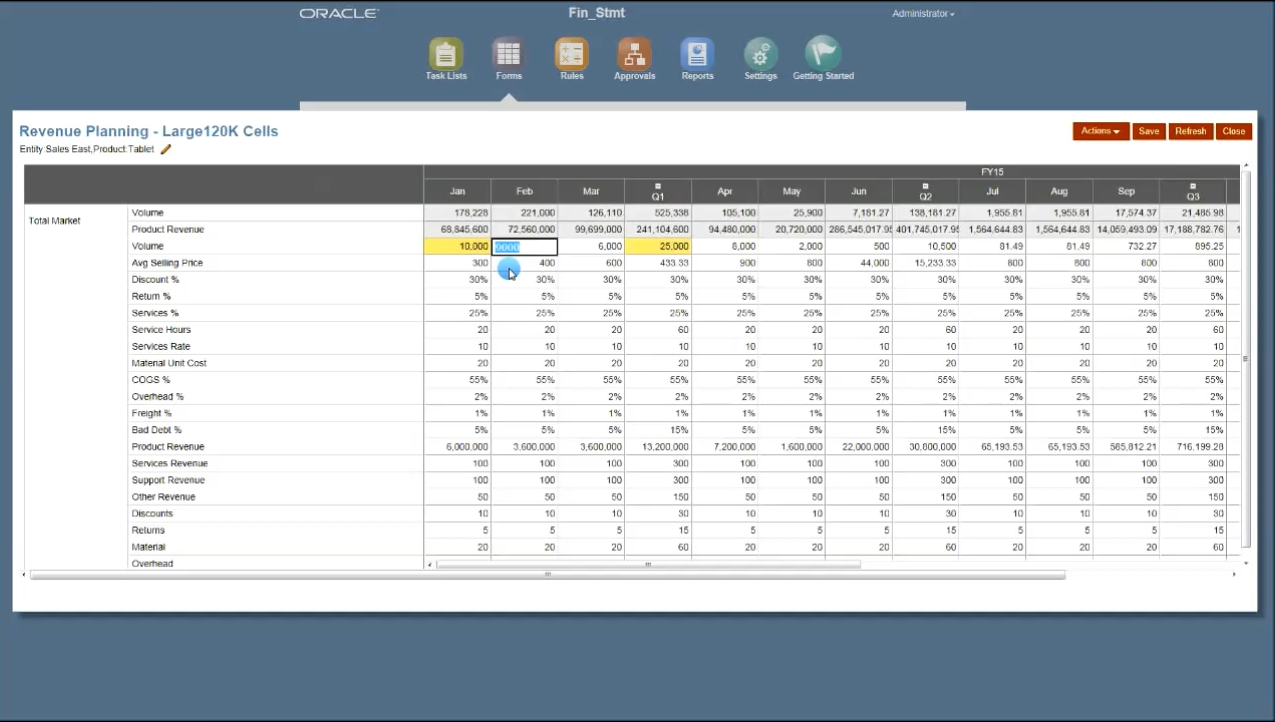
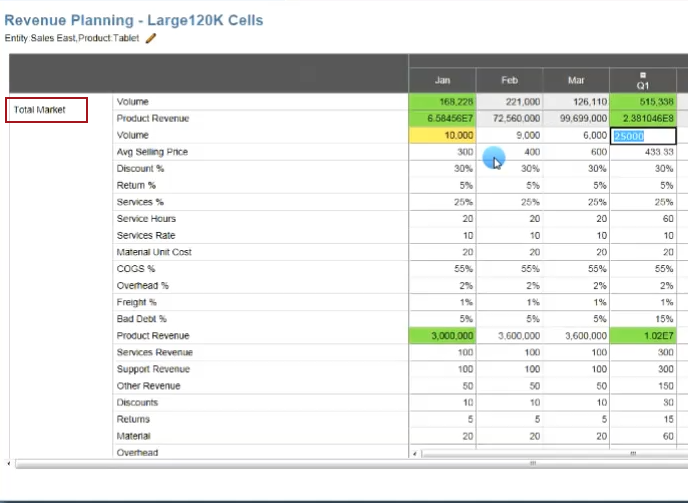
You can see it all here in this video.  Check out the form open (about 120,000 cells) from 00:21 to 00:26 and then near-instant aggregation from 00:35 to 00:37.  

Also check out the following screenshots from the video for those of you too lazy to watch a video.

Calculations

Entering the data at 00:35
Immediate updates to Period at 00:36

Big deal you say – dense intra-block calculations are always fast.  And so they are.
Fully aggregated at 00:37

But a fraction of a second later the entire Market dimension is aggregated as well.  That is not what you would expect from BSO Planning, is it?
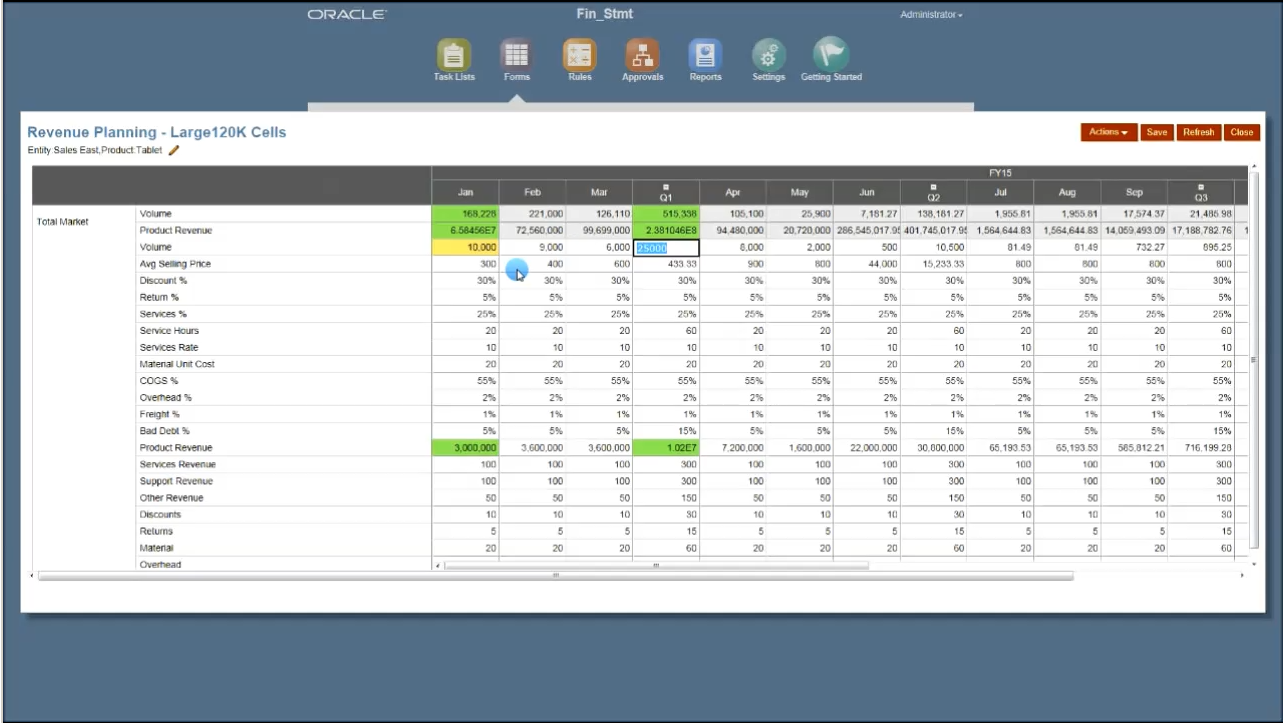
Something you should look at

Look at the numbers in green.  That’s the top of the house sparse Market dimension.  Calculated instantly, thanks to Hybrid Essbase.
Speaking of Hybrid Essbase

What’s the number one thing (way beyond form performance) that drives customers, admins, and consultants nuts about Planning?  Calculation performance is the answer.  What if calculation performance was just about instantaneous?  And the calculated results were also intelligently updated from Essbase back to Planning?  Say hello to Hybrid Essbase as part of Planning.  Yes, the same Hybrid Essbase that Tim German and I presented on at Kscope14 (not as part of Planning) will now be certified for Planning.  With the improvements that are coming in Hybrid Essbase 11.1.2.3.502 (hey, you were at Gabby Rubin’s Essbase Kscope14 roadmap session, right?) you know how D-T-S and Time Balance will be supported along with ASO-like dynamic calculation speeds.

Implications

This new speed in form retrieval, scrolling, entering, sending, and now calculating means that a lot of formerly impossible Planning applications may become commonplace.  

I am emphasizing the may part of this because I think the last thing the world really needs is a 400,000 Entity dimension with 2,000 planners entering bottom up budgets and then watching Essbase/Planning quickly calculate/aggregate the numbers.  Sometimes just because you can do something doesn’t mean you should.

But what I am anticipating is an end to separate ASO Essbase reporting databases built off of Planning applications.  They existed because there was no way to support Actuals reporting in the BSO Plan Types that make up (most of – see the ASO Planning Kscope14 presentation Tim German and I did) Planning.  That is a complete pain and cost unnecessary dollars. Why would anyone go through that if Planning can just support the data depth and complexity?  Look for this concept to be hotly debated but I think the writing on the wall is pretty clear – Planning can be everything you need in a budgeting application, including reporting.  

I also think that driver-based applications that allocate down to a very detailed level will also be possible.  Again, this is a question of scaling that wasn’t possible before with BSO Planning (although ASO Planning can do the job quite nicely).

Totally different kinds of applications, non-financial ones in particular, could very well become commonplace where before they were rejected because Planning couldn’t scale.  Now it can.

Last thought – ASO Planning, which is really a fairly awesome bit of kit, is in sort of an ambiguous situation.  It has the advantage of extraordinarily fast allocations and level zero calculations (even rate calcs – watch this blog for a future post on the power of ASO procedural calcs with Planning), but what will its role be in the face of Hybrid that does so much of the same thing?  Only time will tell but I hope ASO Planning gets a chance as it is a fantastic tool and it is available today.

Sandbox

But performance isn’t the only thing Oracle have on offer – they have a sandbox.  No, not the one you played in as a kid, I mean the ones that planners use to do what-if tests.  I have implemented kludgy ways around this at just about every Planning implementation I have been on (and since I’ve been doing Planning since 2002, that is quite a few) but that was always because the tool didn’t have it natively.  Now it does.

What this means is that planners have private what-if slices of their data that they can play with.  That part is obvious.  What is not obvious is how Planning handles this.

Again, from what I saw and heard (and so I am noting that I may have this wrong), Planning shows base data in a planner’s sandbox but doesn’t copy it to that sandbox.  The planner modifies data, runs calcs, etc. in the sandbox and Planning handles the merge of the base data that didn’t change and the updates to those changes.  

Think of the slice as really only containing the delta between the existing data and the new data – when a planner looks at his Sandbox, he is seeing the merge of the unchanged base data and his adjustments to those numbers.  The UI handles the difference and Essbase (I think) only has to temporarily store a subset of data – this is fast.  This is also an awful lot like an ASO slice.

When the planner is happy with his numbers he publishes them back to Planning (they are private until then) and again Planning only updates the new numbers into Essbase.

Custom members on the fly

This feature that again, just about every Planning client I have ever worked with has wanted, was mentioned as part of the Sandbox feature.  Planning has this today as part of Workforce and Capex and it will now be available in general Planning as well.  If you think about it, this makes sense from a Sandboxing perspective and the fact that it can get published from the Sandbox back to the base Planning app…well, that’s pretty cool.

Client side calculations

This one blew me away – it’s a feature that allows Planners (I’m not totally sure what role does this – Planners, Interactive Users, Administrators, or some new role) to create client-side only calculations that feed their results back to Essbase.

Planners can create these calculations using something that looks an awful like Excel/Smart View (but I believe this is all on the web) and, using Excel formula syntax and cell references, create logic that is posted back to Planning forms and is then calculated on the client side only with the results written back to Essbase.  Whew.  It is, finally, a breaking of the lock that administrators have on calculations.  Again, this will have to be managed, but within the correct context, this is a hugely empowering move for Planners.

In keeping with the spreadsheet UI, Oracle claim they have replicated almost all of Excel’s formulas (so a huge boost over current form calculations).  While developing the client side calculations Excel cell references are used; when posted back to Planning it maps those cell references back to member names.  OMG so cool.

Valid Combinations

The best has been saved for last.  I have personally asked Oracle for this for at least the last four years at Kscope.  Perhaps the annoyed glances I thought I got from Shankar during his Planning roadmap presentations were really his way of saying, “You know, Cameron is a complete PITA, especially since he asks me the same question again, and again, and again at every conference,  but maybe, just maybe, this is something worth looking into, if only to shut him up.”  Perhaps.  And I am almost certainly a complete PITA to all sorts of people at Oracle.  So double perhaps is likely appropriate.

No matter the motivation (many have wanted this functionality for a long time so the above is artistic license/insanity on my part), we will now be able to define valid combinations (get it?) of dimensions for form navigation.  By that I mean, if Entity A is only valid with Products 1, 2, and 3 and Entity B is only valid with Products 3 and 27, those will be the only possible combinations of member selection within the forms, e.g., A can never select 27 and B can never select 1 or 2.  The workarounds we have all done in the past (hard coded forms by user type, more attribute dimensions that you can shake a stick at and still lots of semi-hard coded forms) will all now be a thing of the past.  

There’s even more functionality in this – in addition to the expected form dropdown filtering, it will also be driven by what’s in the POV (think dynamic user variables and it gets quite interesting), and it will be applicable to Calculation Manager rules.  There will even be a report mode that gives us all of the places that people have somehow (could be Essbase, could be forms that don’t use Valid Combinations) gotten data into invalid locations.  

Finally, Valid Combinations will fire first and then user security comes into play.  This is perfect because it’s exactly the way access should work.  First the admin decides what member combinations are valid.  Then planners, who may only see a very small slice of a given valid member combination set, have their security applied.  The result is data where it needs to go and only there.

When can we see all of this?

As I noted way back in the beginning of this post, with luck we will see this on on-premises Planning by the fall.  It will then move to the cloud.  This sort of leapfrogging between PBCS and on-premises Planning is actually occurring today and will continue in future.  

What does this all mean?

Well, one thing it means is I am not going to be able to whine about:
  • Planning being soooo slow
  • How do I stop people from entering data into invalid combinations of members?
  • My super-lame kludges that supported (kind of) sandboxing

Nor will I be able to whine about client-side calculations.  Oracle introduced this before I could even conceive of whining about it.  Shall we call it preemptive counter whining?  Or just a way to get me to shut up?  You decide.

What all of this really means is quite interesting – Oracle are ramping up the performance, adding much-wanted functionality, and doing it all at a super-fast cadence.  I’m really very excited (in case it isn’t obvious from all 2,000+ words above this sentence) about where Oracle are taking the product.  I haven’t seen this much innovation from Oracle since Planning first came out.  Hopefully Oracle will be able to continue the great work and sometime this fall we’ll all be going through the act of installing 11.1.2.4 in our development environments.  A big thanks to Oracle for previewing this at Kscope14.  

What oh what oh what will Oracle preview at Kscope15 in beautiful Hollywood, Florida?  The only way to know is to sign up.

Be seeing you.

27 June 2014

Kscope14 Days 4 and 5

What happened to live blogging Kscope14?

That, as the saying goes, is a great question.  Kscope happened.  I have never, ever, ever been so busy over a sustained period of time as I was this past week.  Ever.

Sleep?  Gave up on it.  Food?  Gave up on it.  Coffee?  Definitely did not give up on it.  Fun, learning, networking, giving?  Gave all I had and more, just like everyone else at the conference.  I will say that not getting sleep at Kscope is par for the course, but literally not having enough time to eat…Not Cool.  I usually carry some kind of energy bar.  Good thing or I’d have completely dropped dead.

So that’s my excuse, I was just too busy to blog.  Surely eating and sleeping do have to have some kind of priority?

 It gets worse and worse every year.  Or is that better and better?  You decide.

So, Cameron, what did you do?

Yet another great question.  Natalie Delemar aka @EssbaseLady and I were comparing notes about sessions post the conference.  I figured out that I managed to go to just two sessions other than my own.  Two.  That’s really a bit disappointing but it does sort of explain why I seemed to live on Mojo bars.

Briefly:
  • Two presentations (ASO Planning and Hybrid Essbase)
    • As an aside, you have not “lived” till you stay up past 1:30 am rehearsing your part of a presentation in preparation for a rehearsal 3-ish or so hours later with your copresenter.  Fun times, fun times.
  • Essbase experts (so what was I doing there?) panel participant
  • Meetings with Oracle
  • Interview with OTN
  • Interview with ODTUG
  • Moderated the Thursday Planning Deep Dive session
  • Attended the two aforementioned sessions
  • Did a meet and greet of (just about) each and every vendor in the exhibition hall
  • Had fun
  • Sometimes
    • Slept
    • Ate

So yes, after all that I think I understand the paucity of sessions.  What a conference.

Yeah, you were busy.  So what?

My presentations with BFF Tim German

ASO Planning – Do this, not that

ASO Planning, is real, powerful, and hugely fast.  Even procedural calcs with a sufficiently powerful hack (If there was a hack meter, and its range went from 1 to 10, this one would be an 11, thanks to Joe Watkins.) can be almost absurdly, did-it-really-calculate fast.  I mean fast.  ASO Planning isn’t for everyone (there are licensing, calculation complexity, and other considerations, but not very many), but if your application fits within its constraints and needs ASO Planning’s speed, I would definitely encourage you to look at it.  It can be magic.

Several blog posts, maybe another presentation, and a webinar or two may come out of this session  – there was a ridiculous amount of content we couldn’t use because of time constraints.    

Hybrid Essbase – Evolution or Revolution

I think it’s safe to say that Hybrid Essbase is a revolution and it will change what we do with Essbase.  It’s almost better than ASO, and I think ASO itself is a very exciting concept and a proven product.  The marriage of an ASO-like aggregation and query processor with BSO is going to solve all kinds of design and performance issues that BSO imposes.  And we get to use BSO’s rich calc script language.  Magic.

The two presentations I managed to see

Glenn vs. Edward

I’ve already blogged about this in my Day 2 post.  As always, the snipping and bickering between the two of them reminds me of an old married couple.  I think they like each other.  And no question, Glenn won that contest.

It’s mostly basic stuff, but I did like the review of Glenn’s accumulation trick.  It’s a clever idea that allows you to get dimension totals while skipping intermediate aggregations you don’t need for allocation purposes.  

There was however something about what he and Edward went back and forth on that bothered me.  As I looked at the code sample, I wondered how the code worked when it was run more than once.

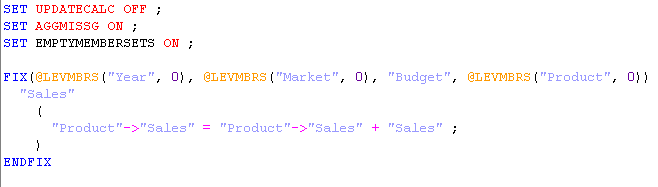
Here’s what it looks like in EAS:

The concept is really quite clever:  loop level zero members adding their value to a top of house (or wherever if you used @RELATIVE and an intermediate hiearchy ancestor) ancestor skipping all of the intermediate hierarchies between the bottom and top levels.  There could be quite a few so time would add up making this a fast approach to get that total for allocations or whatever the purpose is.

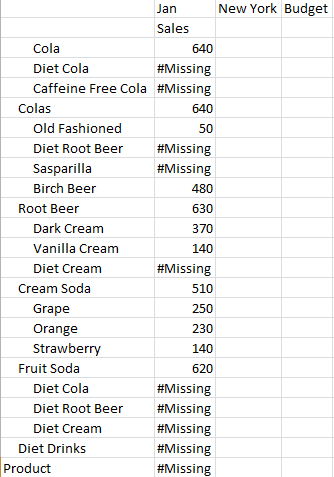
Does it work?  

The answer is yes.
Before accumulation
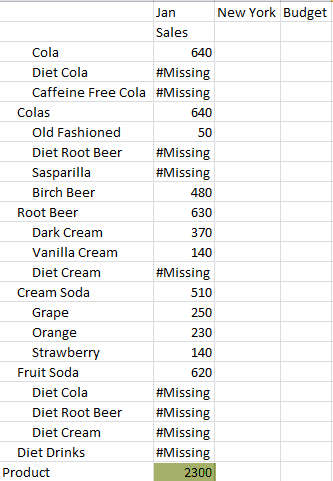
After accumulation
A run of Glenn’s code gives us the 2,300 we would expect.
The sting in the tail
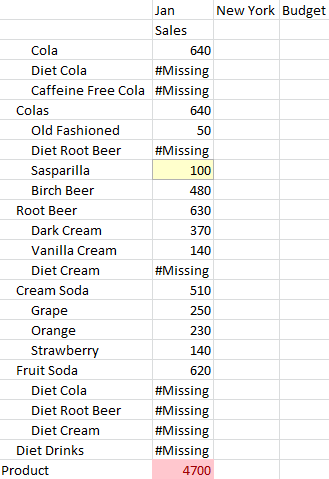
So what happens if 100 is entered into Sasparilla?

Unpossible!  But all too true.  What happened?
The explanation
Simply that there was already 2,300 in Product->Sales and Glenn’s technique added another 2,400 (the already existing 2,300 from all of the existing level zero Products and the new 100 in Sasparilla).  If the technique doesn’t clear beforehand, the code will return unpexpected results.

I can almost hear Glenn say, “But it’s not an aggregation, it’s an accumulation.”  And so it is, and it is fast.  Having said that, usually well-written BSO calc scripts can be run one or a thousand times in a row and return the same result each time.

If you want to use this technique, make sure you have a way of clearing out that top Product->Sales member before you run this code.

NB – It’s not that this accumulation approach is bad (I actually like it else I wouldn’t bother to highlight it), it’s that it breaks the normal behavior of Essbase aggregations if the developer isn’t careful to remember that he isn’t aggregating, but instead using a clever hack.  

Glenn, MMIC, you may very well have stated this and it flashed by me, but I sort of don’t think so and this could really trap the unwary.  If you talked about it, think of this as a further illustration of your amazing acumen.  If you didn’t, I’m here to correct your mistakes.  :)  Heaven knows if I am correcting a mistake or oversight, this might be the second or maybe the third time.  I contrast that with the 100 (at least) going the other way.

Speaking of the power of Hybrid, see Planning on the cloud

Shankar Viswanathan and Prasad Kulkarni really wowed the crowd on this one.

The big deal(s):
  • Really big grids really, really, really fast.  Faster even than Smart View.  Did I mention they were big?
  • Client side calcs via an Excel-like editing metaphor that post back to forms.  OMG cool.
  • Intelligent sandboxes (finally, as I have kludged this at just about every Planning client ever)
  • Valid combinations
  • And of course Hybrid
  • Did I mention that all of this is coming to on-premise Planning?

I’m going to write a blog post on this one as well as there’s simply too much to go into but the act of opening up a 120,000 row grid, changing drivers, having it flow through into calculated results, and then aggregating immediately, live, well this particular geek almost swooned.  Just as well I didn’t as the choice was either the carpet or the metal frame of a chair.  I like all of my teeth and I like them still in my mouth.

In other words, Planning cloud demoed really well.  If it works half as well as it demoed, they will have knocked the ball out of the park.  If it works as well as they showed…well, that will simply completely change the way we architect Planning solutions.  Interesting and fun times lie ahead.

We can (if all goes well) hopefully expect this around the end of the year although as always Oracle reserve the right to say it was all a gigantic game of Let’s Pretend.

If it didn’t happen on social media, it didn’t happen at all

I have a steam punk smartphone, aka, it’s five years old and its camera isn’t exactly on the cutting edge of functionality.

Happily I happen to know some people who are apparently not as cheap as I am (the phone, text, and email bits work, mostly, just fine, thanks) and thus can actually provide photographs that can illustrate all of the cool parties that only happen at Kscope.  Thanks go out to Leticia and Jessica Cordova (yes, they are sisters who work together in EPM and that is actually pretty cool) who were kind enough to take time out to get some great shots of the entertainment and send them to me so I could post them here.  

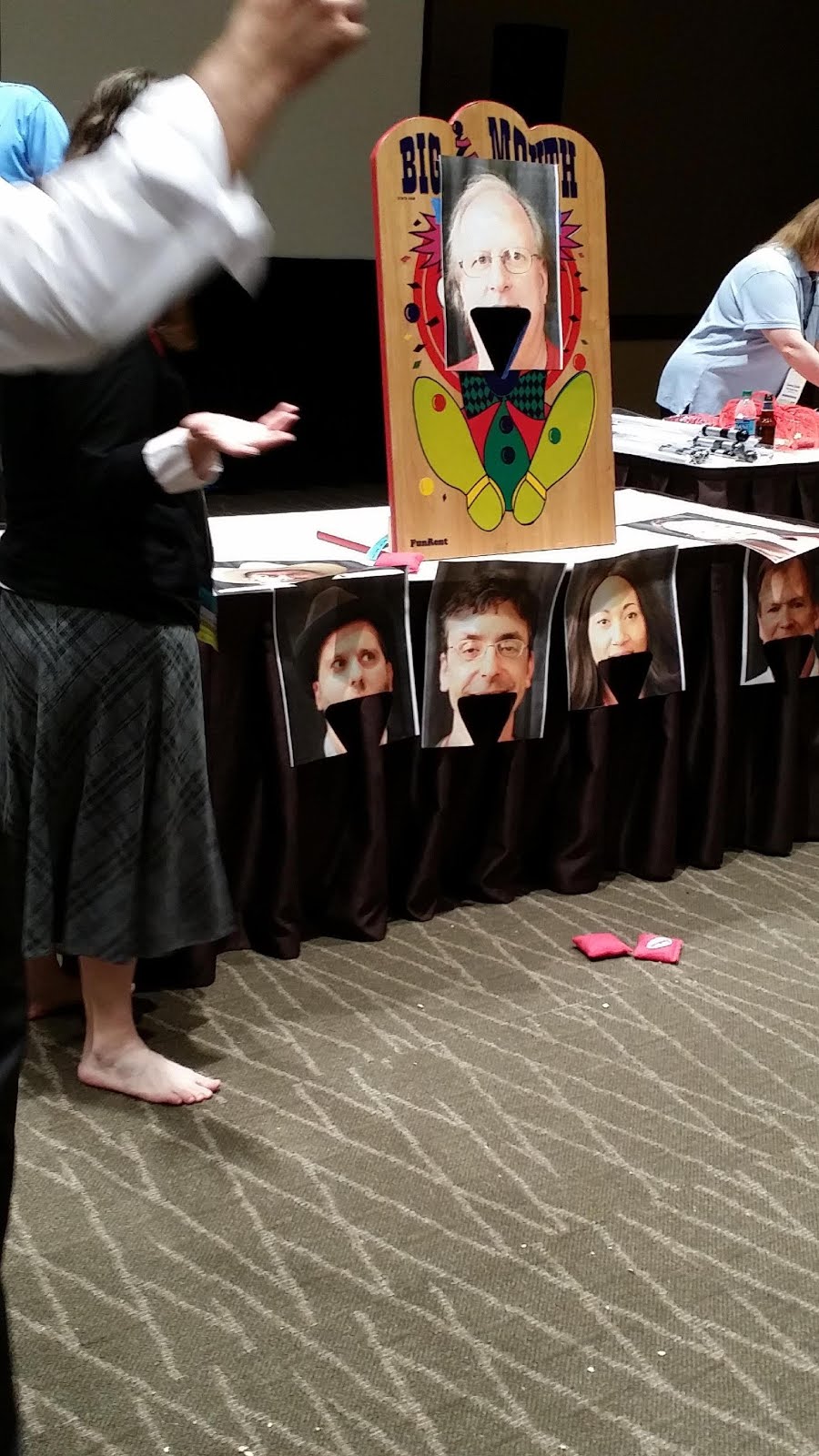
Monday night EPM carnival

You’ve seen the madness here, now see it in a legible and disturbing photograph.  Correction, very disturbing photograph.  Was a message being sent?

Space Needle

Tim Tow of  AppliedOLAP and Jonathan Berry of Accelitis threw a great big shindig at the Seattle Space Needle.  That was super cool, and the view from the top was amazing.  Of course, what do people take photos of when they’re at the top of a tall building that overlooks a beautiful city?  Other people on top of that tall building.  

Buddies

Jessica, yr.obdt. svt., Leticia, Jason Jones

p3

Okay, to be fair, here is why cell phones are not used to do real photography:
p4
But it’s still a pretty cool picture.

EMP

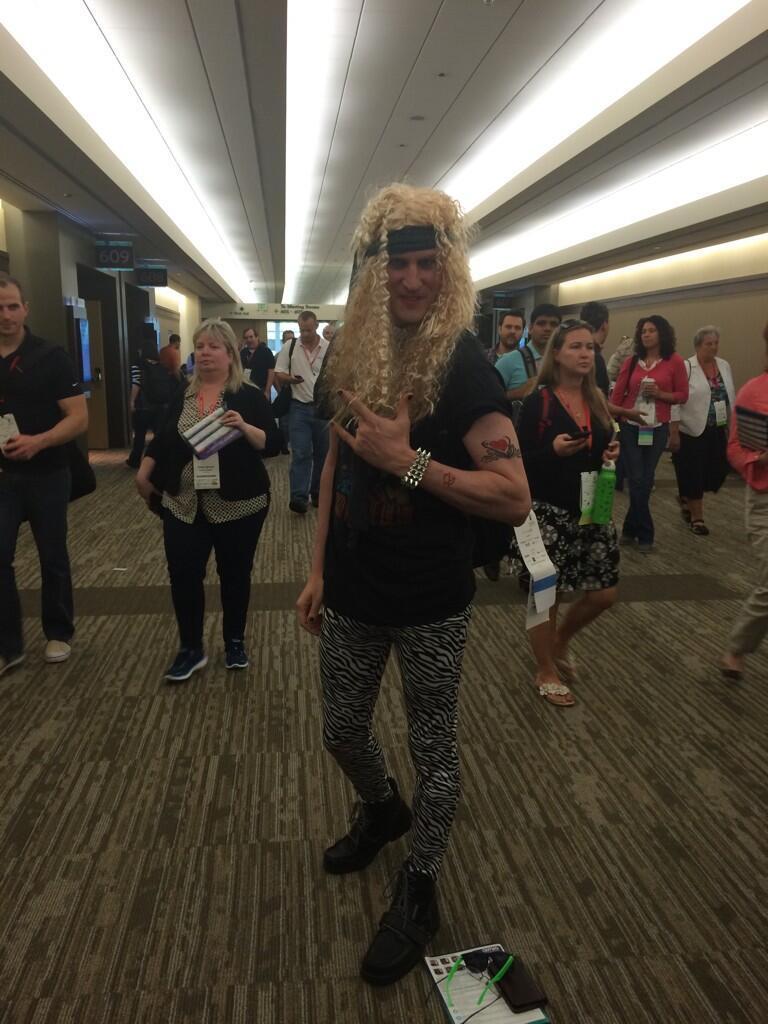
Here’s my buddy Joe Aultman looking…weird

It was sort of interesting when Joe walked into my Hybrid presentation and sat in the front row as I was halfway through a slide.   I just about lost it.  This shot of Joe, at the conference well before he actually needed to look like a refugee from a big hair band, is stolen from @EssbaseLady.
pj

Guitar sculpture

p5

Sky Church video screen (insert sounds of pounding music to get the right feel)

p6

Some total geek with (apparently) Tina Turner and Madonna-no-it’s-Cindy-Lauper-no-it-is-some-sort-of-generic-80s-female-rocker

p7
Do I look like money?  I’ve got it on my fingers and round my neck.  But not in my wallet.  Sigh.  Perhaps the glare from the bling is why my eyes are closed?

Btw, that is Natalie Delemar, conference chairwoman on my right and Opal Alapat BI/EPM content chairwoman on my left.  I understand each and every one of us has a serious, real, and responsible job.  I agree, it is somewhat hard to believe.

Professional dancers (really quite good; certainly better than drunk geeks getting it on)

p8

Amazing aerialists

p9

In short, as only Kscope seems to be able to do, an outstanding series of entertainment events.  No one does it like ODTUG.  No other conference is like Kscope.

And now we begin planning Kscope15

Kscope14 was the best Oracle user conference ever, bar none.

ODTUG will now make Kscope15 the best Oracle user conference ever, bar none.  That means it will beat Kscope14.  Such is the penalty of awesomeness.

That awesomeness doesn’t come from Seattle, or the EMP museum, or a really nice convention center, or even the awesomeness of new product demos and strategy direction Oracle give.  Kscope isn’t about technology at all, it’s about people.  People who give time, effort, and money (never forget the opportunity cost of all of that time) to make sure that attendees meet life-altering friends, learn career-changing techniques and theory, and experience the transformative opportunities that only physical contact with a group of like-minded individuals can bring.  Those communities are what make ODTUG and Kscope special, and in some way they’re what makes Oracle the special and successful company that it is.  It all comes back round to people and Kscope is the vehicle that unites those people.

Every conference is like magic in a bottle and I begin thinking about the next one before the current one has even finished.  Only crazy (I am sort of sure I’m not crazy.  I think.) or crazily passionate (guilty as charged) people think that way but the awesomeness of Kscope has that kind of influence. 

If you work in Oracle technologies, and you don’t come to Kscope, you’re crazy.

See you at Kscope15!

24 June 2014

Kscope14 Day 3

Oh my goodness

Are we really at the halfway mark?  I suppose it depends on how you define the start of Kscope14.  Given my state of tiredness, I don’t know if I can count to 5 (or is it 6 or is it 4?) and then do a divide by 2.  No matter, Kscope14 is now in full swing.

And what does that mean, Cameron?

It means busy.  I should note that this state of business is true for everyone, not just me.  Or maybe especially not me.  I, thankfully, don’t have to work a booth.  I do have ODTUG (not too bad) and OTN (quite nice, actually) responsibilities but compared to doing the meet-and-greet that conference booth duty entails it’s nothing.  So I am not (well, maybe just a little, but this is hopefully the last time today) whining too much about it.

No really, what?

I am actually relaxing right now listening to Gary Crisci explain the nuances of ASO Design Principles for Financial Reporting.  I feel so…calm listening to Gary.  He’s really an excellent presenter:  a good speaker, extremely logical, and very, very, very thorough.  Yes, I am a fan.  And, unlike me, Gary is relaxed.  Isn’t he a little bit like Rick Moranis’ satire of Perry Como?  Perhaps I am the only one who sees it?

So where was the stress?

I am not presenting today but I was on two panels.  

The first was at 8:30 (eek!) on Tim German’s Essbase Optimization Panel with John Booth, Dave Collins, Edward Roske, and MMIC Glenn Schwartzberg.  Considering breakfast consisted of two cartons of milk and an energy bar (I have too little time to eat – That Is A Bad Thing) I think I managed not to embarrass myself too much.

The second, the OTN-sponsored Essbase ACE Lunch and Learn was at lunch time (food, so this was good).  It was moderated by the aforementioned Gary Crisci and the panelists included yr. obdt. srvt., Glenn Schwartzberg (Glenn, like me, fits the idiom a bad penny always turns up), Tim Tow, and John Booth.  

And that was all a bit tiring.  Happily, I am mostly obligation free for the rest of the day.  That means I get to look forward tonight to rehearsing with Tim German for our Evolution or Revolution:  The New Hybrid Essbase session.  For those of you interested in seeing the future of Essbase development (surely everyone?) you really ought to be there at 11:15 in room 604/603/602.

So is the above a whine?  I guess you could argue that it is, but it’s all tremendous fun, despite the level of effort, and I wouldn’t trade it for anything.

Are you here?  Do you agree?  What, you aren’t here?  Why?

If Oracle technology is important to you, and you like to stay informed, aka employed, I can’t think of any other place on God’s green earth that is a better place to learn, meet the experts (obviously someone other than me), have fun, and figure out what the next step in your career will be.

I know I’ll see you next year.

And for those of you who are here, don’t you agree?  Send your huzzahs care of this blog.

Be seeing you.