Want to know The Truth About CPM?
Showing posts with label Dodeca. Show all posts

23 June 2017

The Dodeca Symposium at Kscope17

Parallel Lines

One way or the other

Tim Tow, president, CEO, and general Applied OLAP grand visionary has wanted a Dodeca symposium for ages – Five years?  Seven?  A long time for sure. – and come this Kscope17 it has finally happened.  

That’s right – this Sunday, 25 June 2017, at Kscope17, you can see the best spreadsheet management tool – aka what Excel and Essbase should be – in its very own track running at the same time as Oracle's symposiums.  This is big news both for Applied OLAP and ODTUG as there has never been a parallel (or any kind of for that matter) non-Oracle symposium at any Kscope.  Congratulations are due to Tim and his team for making this finally happens.

Sunday Geek

Do Symposiums have roadmaps?  New product announcements?  Customer presentations?  Deep dives?  Q&A with product management and development?  Dodeca has that and more.

If you use Essbase and you’re not using Dodeca, you owe it to yourself to attend.

This is all taking place in the Peony room at the JW Marriott San Antonio hotel.

Picture this

Sunday isn’t the end of Dodeca content at Kscope for there are sessions throughout the week.  Note that these are almost exclusively by customers, not consultants aka The Wretched of the Earth.  NB – I am a consultant and I heartily encourage you to come to my sessions but there can be no greater recommendation than that of a satisfied buyer.  Ask the geek who owns one.

Applied OLAP: Dodeca Customer Panel - Dodeca Customers Make Essbase Their Secret Weapon
Tim Tow , Applied OLAP, Inc.
When: Jun 27, 2017, Tuesday Vendor Presentation, 9:45 am - 10:45 am
Room: Grand Oaks H
Topic: Vendor Presentation - Subtopic: Vendor Presentation
Learn how Abbott, The Kroger Company, Wells Fargo, Williams Energy , and LinkedIn combine Dodeca and Essbase to solve their business needs. Like many companies, they have diverse requirements. Join this session to find out how they implemented and build upon their Essbase footprint with the Dodeca Spreadsheet Management System. Participate in the Q&A session and ask questions directly to the panel. Dodeca - not just for planning, reporting, and analysis.

Essbase Does It, but Dodeca Makes It Easy! (The Sequel)
Stuart Yasukochi , Abbott (formerly St. Jude Medical, Inc.)
Co-presenter(s): Doug Pearce, Analysis Team
When: Jun 27, 2017, Tuesday Session 8 , 2:00 pm - 3:00 pm
Room: Grand Oaks G
Topic: Essbase - Subtopic: Essbase-related technologies
St. Jude Medical identified three key technical hurdles to converting their worldwide planning applications to a single ASO database. Learn how Currency Translation, Workforce, and Supporting Details’ complex functionality was achieved using core Essbase functionality with Dodeca’s versatility. Seamless integration between relational input views and Essbase provided for employee-level workforce planning and generalized supporting details inputs. Simple operations in BSO are not so simple in ASO such as currency conversion. Join us to learn how SJM was able to surmount these obstacles with increased efficiency and reduced complexity.

Did You Know Your Local Grocer Uses Essbase?
When: Jun 27, 2017, Tuesday Session 9, 3:30 pm - 4:30 pm
Room: Peony
Topic: EPM Business Content - Subtopic: EPM/BI Strategies
Kroger is scaling Oracle Hyperion Essbase to 25,000 users and putting timely data in the hands of the tactical resources in thousands of stores. Stores can drill through to invoices, write back their labor estimates, and manage allocation factors that are critical to corporate through the Dodeca interface.

Introduction to Java and the Essbase Java API
Tim Tow , Applied OLAP, Inc.
When: Jun 28, 2017, Wednesday Session 13, 11:15 am - 12:15 pm
Room: Grand Oaks H
Topic: Essbase - Subtopic: Other Essbase
Many Essbase customers and partners have requirements that extend beyond the 'out-of-the-box' capabilities shipped with the product. Thankfully, Essbase is a platform that features a very robust Java API that provides nearly endless possibilities allowing customers the ability to leverage their Essbase investment. Attend this session to learn the basics of how to get started with the Java programming language and with the Essbase Java API.

We Make Energy Happen: Oracle EPM Client Success Story at Williams
David Wells , Williams
Co-presenter(s): Arijit Chanda, Williams
When: Jun 28, 2017, Wednesday Session 16 , 4:15 pm - 5:15 pm
Room: Grand Oaks H
Topic: Essbase - Subtopic: Essbase-related technologies
After an enterprise-wide reorganization, the FP&A group was faced with growing business requirements, slow and outdated systems, missed deadlines, and frustrated users. Learn how Williams super-charged its EPM environment using Planning, Essbase ASO, and Dodeca to cut processing times from four hours to 15 minutes and increase data capacity by over 10 times. With the system bottlenecks removed, the finance organization is not only meeting deadlines, but performing more comprehensive analyses and other projects neglected previously due to system restraints.

That’s an unprecedented amount of content for a non-Oracle product and proof, if proof be needed, that Dodeca and Applied OLAP are leaders in the Oracle EPM space.

I know but I don’t know

The story of my life although I’m pretty sure I know that I don’t know.  But do you need to be in this perpetual state of barely self-aware ignorance when it comes to Essbase and spreadsheets?  No.  And how do you solve that?  Attend Kscope17 (natch) and the Dodeca sessions starting with this Sunday’s (just two short days from now) symposium.

Will anything happen?

You will learn how and why Dodeca customers love Dodeca.  

You will learn how you can Make Essbase Great Again.

Geek of Glass

In case it isn’t obvious I am a huge fan of Dodeca (I even wrote a book chapter about it).  Also, if you clicked on the links in this post you’ll have noticed that I am also quite a Blondie fan although even I can’t stretch a connection between the two.

Join me, the Applied OLAP team, and most of all Dodeca’s satisfied customers this Sunday, won’t you?

Be seeing you.

10 September 2015

Developing Essbase Applications: Hybrid Techniques and Practices is now available on Kindle

Huzzah!  It’s finally for sale!

Thanks to Anonymous’ comment (thanks, Anon) on the prepublication blog post for DEA Hybrid, world+dog now knows that the book is finally, finally, finally available for purchase so long as the reader isn’t tied to  dead trees and ink.

Click here or on the big pretty cover below to buy, buy, buy.  Buy enough of these and there will be a third DEA book.  Don’t and CRC Press will avoid me like a deadbeat dodges the bill collector.
K25678_v1 rev

Limit one per customer, but only for the hardbound book

Imagine my surprise when I tried to preorder 10 copies of the book as I must somehow boost sales.  Unpossible!

If you have a Kindle, would you mind sending me a picture?

I have a halfway decent cellphone with a camera, but I don’t have a Kindle.  Would someone, anyone who knows my Twitter or email address, please take a snap and send it to me?  I’ll insert it into this post and give you credit.  Thanks in advance.
  
Edit for Kindle
And now, thanks to John Booth, I now have a (stolen) image of DEA:  Hybrid.  John, thanks again..


Be seeing you.

02 December 2014

Stay tuned to this station for important information

The first hurdle passed

For those of you wondering why I seemed to have dropped off the face of the social media earth, I have been busy, busy, busy.

What have I been busy at?  Another book.  And it’s not about geeks and cats, the pictures in this post notwithstanding.  Nope, it’s the follow up volume to Developing Essbase Applications.

I’m going to leave the details a mystery (but yes, it is a group project to end all group projects, again, and yes we have a publisher and a contract and all of those wonderful things so it’s all for real)  as there’s still much to do and I don’t want to jinx the project.  For those of you who follow me on Twitter (I know for a fact that you do not, cf. my past blog post on blog readership so why don’t you get with it and read my even more frequently updated drivel and inanity), will have seen my tweet last night which ought to give you a hint as to what one of my chapters is about.
No, it is not a book Karl Malden, although I do encourage everyone to watch The Streets of San Francisco as it is an excellent police procedural.  And all of the cars are from FoMoCo.  And it is a Quinn Martin Production, so it has to be good.

In any case, that’s the scultpure that inspired the name Dodeca.  If that isn’t enough hints, I don’t know what is.

In any case, I thought you might like to see yr. obt. svt. at work so you can all thank your lucky stars you don’t do something as stupid as writing a book.  Fwiw, my royalty share on Developing Essbase Applications is 32¢ a copy.  It sure ain’t a road to riches.

So what am I doing?  Below you see my cats helping me out as I edit my first draft.  That’s Peanut sitting on the chapter, perhaps providing editorial comment by sticking her rear end on half of the chapter.  In the front Is Adam, looking incredibly bored, so perhaps yet another editorial comment.

I apologize for the mess.  This is the dining room and my maelstrom of stuff has hit this room.  All I can say is you should see my office.  Eeek.  I had to leave the untidiness behind me and ruin another room.  

Yet another picture – OMG, I have to clean.  And get Peanut off my manuscript.  Cats are such stinkers.

I feel sort of bad wasting your time with cat pictures but isn’t the internet all about watching cat videos? I’m just joining the club.  And they’re great cats.  Both are rescues from the mean streets of Philadelphia.  Adam, the older of the two, was rescued in Fitler Square where I used to live, and Peanut from under a truck in Chinatown.  I will spare you my rant about strays and unthinking owners.

So what’s next?

Cleaning my house?  Definitely.  After that, the editing process, getting the other chapters in, all of the fun legal stuff with Oracle (yes, they vet the whole thing, give us permissions to show screen shots on an image by image basis, etc. but don’t worry, it’s our content).

After all of the chapters are complete and we’re actually in the process of the second draft, I’ll share some detail about the book.  I’m very excited (and relieved that I got this chapter done, only ½ of another one to  go) about our work and I think it will be valuable to world+dog.

Be seeing you.

15 July 2013

An even better focused aggregation with Dodeca

The obligatory disclaimer

I gave a presentation on this very subject at the Hyperion SIG Open Microphone Night.  I am not entirely sure that a formal (well, informal, but it was PowerPoint) presentation is 100% a spontaneous thing, but they asked, I double-checked, they agreed, and so it was.  


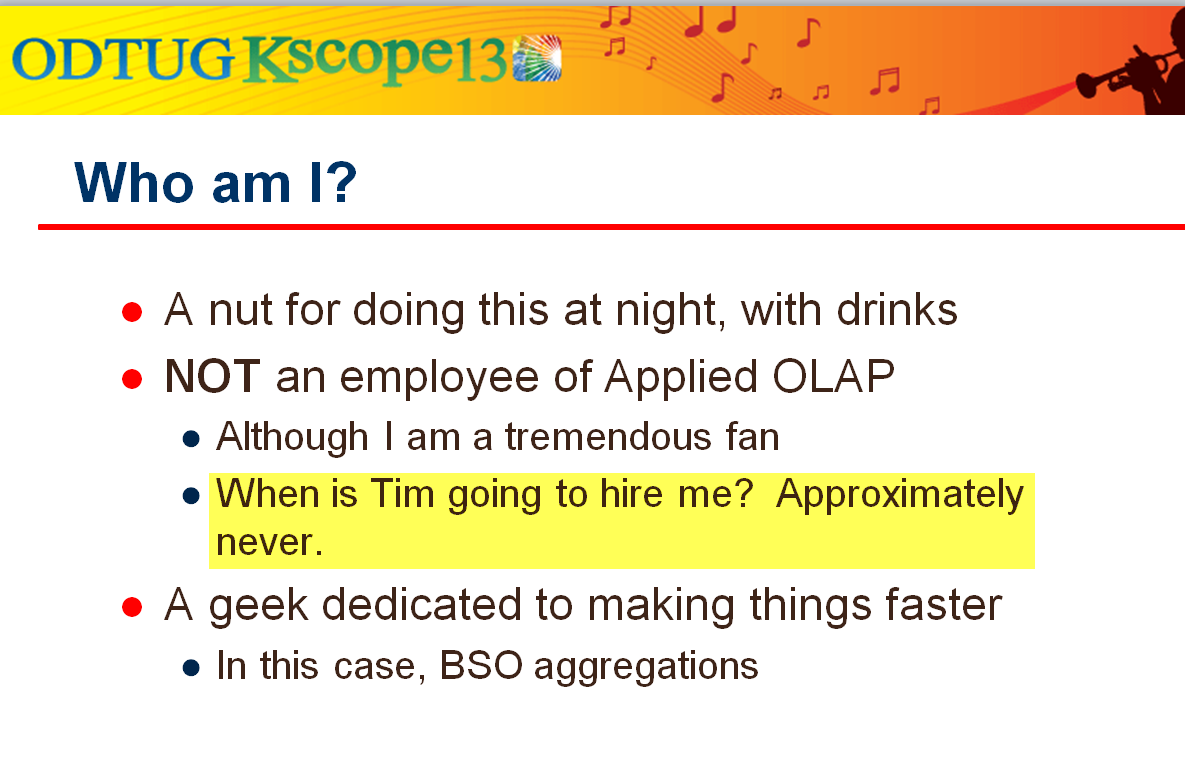
The disclaimer?  I am a cheerleader for Dodeca, but not a salesman, not an employee, not a shareholder, etc., etc., etc.  Here’s the who-is-this-nut-in-front-of-the-room graphic for those who doubt.
Also, for the record, there were alcoholic drinks there but there was also…chocolate milk and regular milk.  2% and skim.  And cookies.  Yum.  It is somewhat incongruous to admit this at my age, but I really like the taste of milk.  I like mixing chocolate and regular milk (so I guess I like watered down chocolate milk) even more.  What an awesome idea for snacks.


Back to Dodeca – I like the product, a lot, I don’t do very much with it (if I could sell it, I would, but I can’t very much so I don’t), I do consider Tim Tow both a friend and a mentor, and that’s it.  If this post reads like an advertisement, it isn’t.  It’s just what the very last bullet point says it is – an interesting way to make processing faster.


Whoops, one more thing.  It would be awesome if Planning could pass the contents of the rows and columns to Calculation Manager.  Awesome.  As you will see if you but continue reading on, gentle reader.   

The good and the bad about focused aggregations

In Planning-land, focused aggregations off from forms, at least in the BSO Planning world almost all of us still live in, is the only way to fly.  You can read all about it here in detail.


Very, very briefly, the big win is only to calculate the ancestor blocks that are affected by the form.  In other words, instead of aggregating an entire dimension, including lots and lots of hierarchies that are not affected by the form input, just aggregate the hierarchies that matter.  It’s that easy.


As an example, let’s take a look at the Planning sample application and compare the calculation time of a CALC ALL (not something you are likely to do, but still a valid data point), an AGG of just the two sparse dimensions, and then of course a partially focused aggregation.  Remember, this is with Entity in the form row and Segments in the page dimension so Calculation Manager can read Segment via a Run Time Prompt variables but not Entity.


Approach
Seconds
Percent
Calc All
5.766
3696%
Agg of Entity & Segment
0.375
240%
Agg Entity and focused Segment
0.156


The blocks tell the tale

When we look at how many reads and writes occur, and how many cells are touched via a SET MSG DETAIL statement, it’s easy to see why a focused aggregation is so fast – it simply touches fewer data points.  To quote Ludwig Mies van der Rohe, “Less is more”.


Approach
Sparse writes and reads
Sparse cells addressed
CALC ALL
22,236 writes
107,570 reads
101,820,000

Agg of Entity and Segment
2,869 writes
10772 reads
12,592,000

Agg of Entity, focused Segment
888  writes
2,960 reads
3,897,400


Last bit of review

The code looks like ugly but this is how BSO Essbase walks the hierarchies when it does an AGG of sparse dimensions.  Weird, it’s true, but it works.

That was the good, here’s the bad

But focused aggregations in Planning have a problem – while they can read the point of view dimensions and drop down or page dimensions, whatever dimensions are on the sheet, and those dimensions’ members are terra incognita to Calculation Manager.  


Why care about row and column dimensions?  If the dimensions are dense, and if I’ve designed the Planning app, I don’t care – everything is dynamic.  But if the dimensions are sparse (and if I’ve designed the Planning app I will have fought this tooth and nail but sometimes that’s just the way people interact with data), I do care because that means any aggregations off of the form will require a full AGG.  Not so focused, is it?


What oh what to do?  In Planning – there is not a blessed thing.  However, what if the application in question was Dodeca?  

What Dodeca can do

The problem with the focused aggregation approach in Planning is as I stated – I don’t know what the sparse dimensions on the sheet are, nor do I know the scope of the member selections.


If I did know that, why then I could write focused aggregations up to the top of the dimension and down to any subtotals.  In other words, a super focused aggregation with hopefully super fast results.  How oh how do we do this?  It’s actually quite easy.

Dynamic Rowset to the rescue

All I need to do is modify the approach I wrote about back in December of 2012 on how to do a dynamic rowset report in Dodeca and change the database from Sample.Basic to the Planning sample application.  And once I do that, I then need to take advantage of the selected Entity and insert it into my Dodeca-specific calc.


To review:  a Dyanmic Rowset report takes a user selecting in a dimension, figures out what the descendants (or children or siblings or whatever) are, and then sticks all of them on a sheet via an Essbase report scritpt, MDX query, or delimted list.  Dodeca does all of this through something called a Workbook Script – sort of Dodeca’s enlightened approach to coding.


Set up a few ranges on the sheet to indicate where the retrieve range is and where to insert rows, and then “code” by modifying the below Workbook Script that fires when the workbook itself opens up, but before it retrieves.


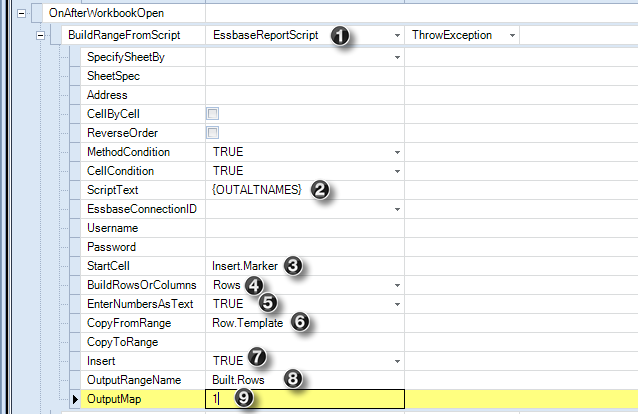
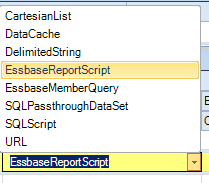
  1. BuildRangeFromScript – I chose the the EssbaseReportScript type; there are many ways of doing this including MDX (cannot be seen because this is an older release):


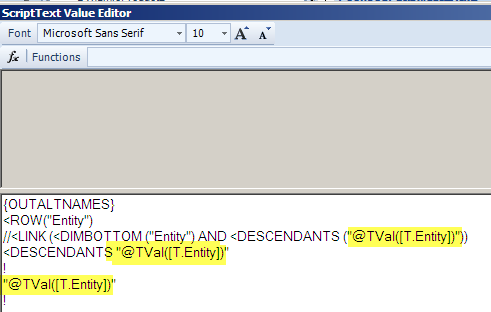
  1. ScriptText – Code to actually build the rows.  Tokenized to push the value of the select from the dimension treeview.


  1. StartCell – Range name of the repeated rows that are tied to the output from ScriptText.  This is the green range.
  2. Rows – This report has dynamic rows; it could just as easily be columns.
  3. EnterNumbersAsText – Just in case member names such as 100 are used, treat them as text.
  4. CopyFromRange – The name of the range to be repeated.  This is the blue range.
  5. Insert – Set to TRUE as I want the output of ScriptText to be reflected in the sheet.
  6. OutputRangeName – The name of the rows that are built during the insert process.
  7. OutputMap – The column that receives the output of ScriptText.
When all of that is built, and the rows are placed onto the sheet, Dodeca does its retrieve.  Magical, isn’t it?


A short note about tokens

Do you like Planning’s Run Time Prompt variables because of their utility in Calculation Manager?  If so, you will really like Dodeca’s tokens because they are even more powerful.  Tokens work in report scripts,  calc scripts (just like RTP variables in Calculation Manager), and they work in retrieves as well.  


You saw above how a token with a Workbook Script function to force the valuation of the token worked in getting the content’s of the rows


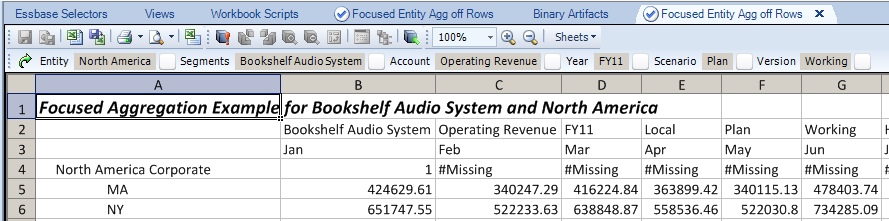
Within a report (aka an Excel sheet) before:


And after in Dodeca:


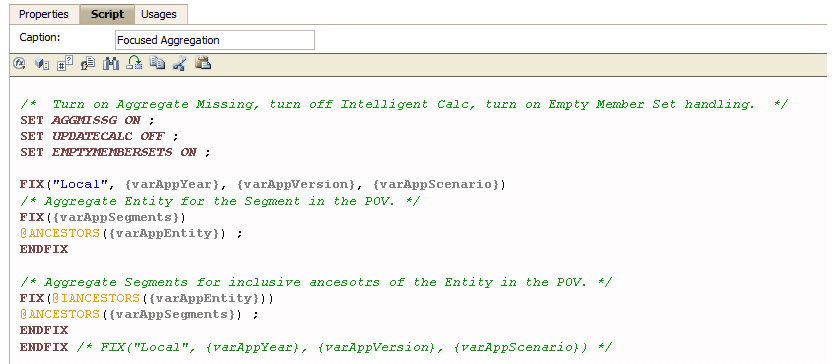
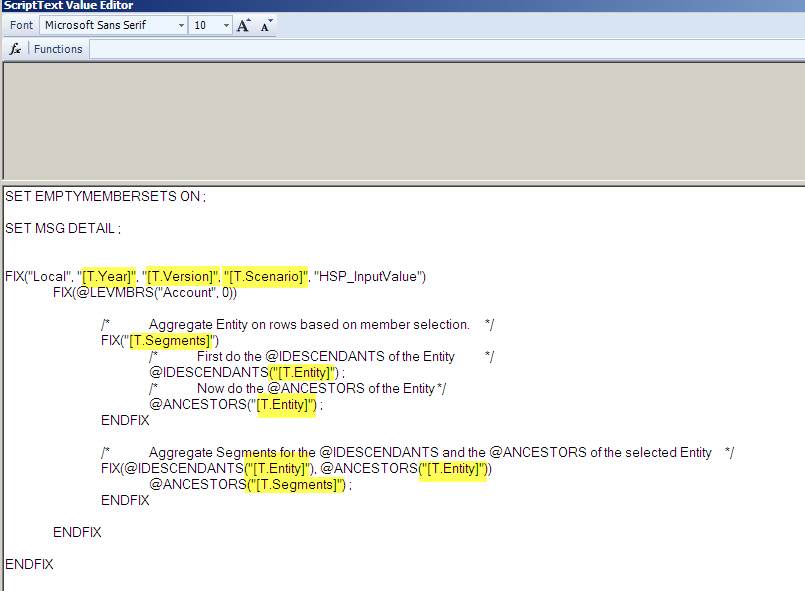
And in the calc script itself:

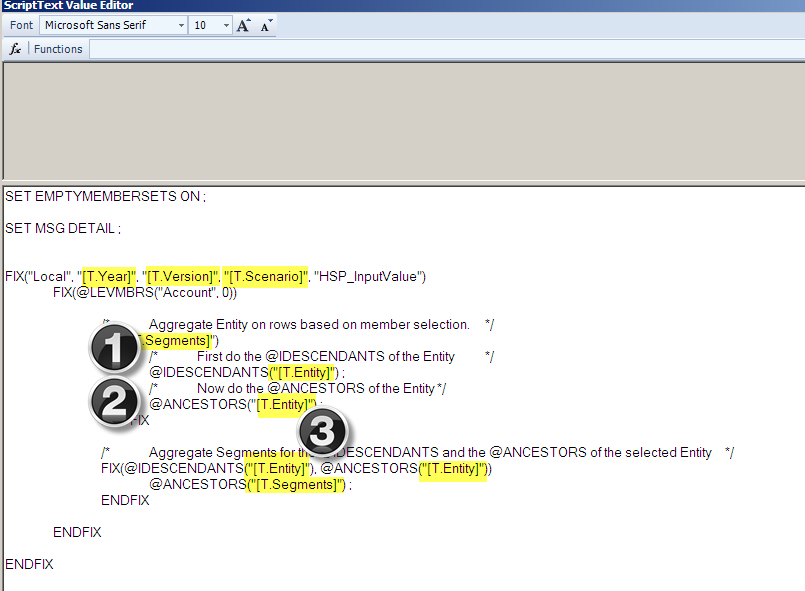
Did you catch the clever cannot-be-done-anywhere-else bit?

It’s as easy as 1, 2, 3.
1 – After fixing on whatever the Segments dimension member is, calculate the inclusive descendants of the Entiy dimension that drives the rows.
2 – Within that same FIX, calculate the ancestors of the Entity dimension.
3 – Then FIX on the inclusive descendants and the ancestors of the Entity dimension that drives the rows and aggregate the ancestors of the Segments dimension.


We’re done.  It was easy, and awesome.

What’s the payoff?

Time

The payoff is speed, a lot of it.  Let’s review the speed again, but now with the above row-based focused aggregation.  The difference is dramatic.  The Dodeca focused aggregation is 93 times as fast as a Calc All, 6 times as fast a dimension aggregation, and 2.5 times as fast as a partial focused aggregation.  Would you like to speed up your budgeting aggregations by a factor of 6?  Or 2.5?  You bet you would.  And you can, quite easily.
Approach
Seconds
Percent
Calc All
5.766
9300%
Agg of Entity & Segment
0.375
605%
Agg Entity and focused Segment
0.156
252%
Dodeca agg of focused Entity and Segment
0.062

Blocks

We can look at time or we can look at the blocks.  If time = money, then time also = blocks.  The fewer are most definitely the better.  The percentage improvements in sparse cells touched by the aggregations mirror the time pretty closely.  
Approach
Sparse writes and reads
Sparse cells addressed
Percent
CALC ALL
22,236 writes
107,570 reads
101,820,000

7733%
Agg of Entity and Segment
2,869 writes
10772 reads
12,592,000

956%
Agg of Entity, focused Segment
888  writes
2,960 reads
3,897,400

296%
Dodeca focused Entity and Segments
300 writes
1,000 reads
1,316,700

Takeaways are not necessarily fish ‘n chips

1 – Focused aggregations are good because they can make your aggregations quick.
2 – Planning can’t give you the rowset for a sparse aggregation although it’s way better than nothing.
3 – Dodeca can give you the rowset for a sparse aggregation through a combination of Workbook Scripts and Tokens.


Try it, you’ll like it.  :)